
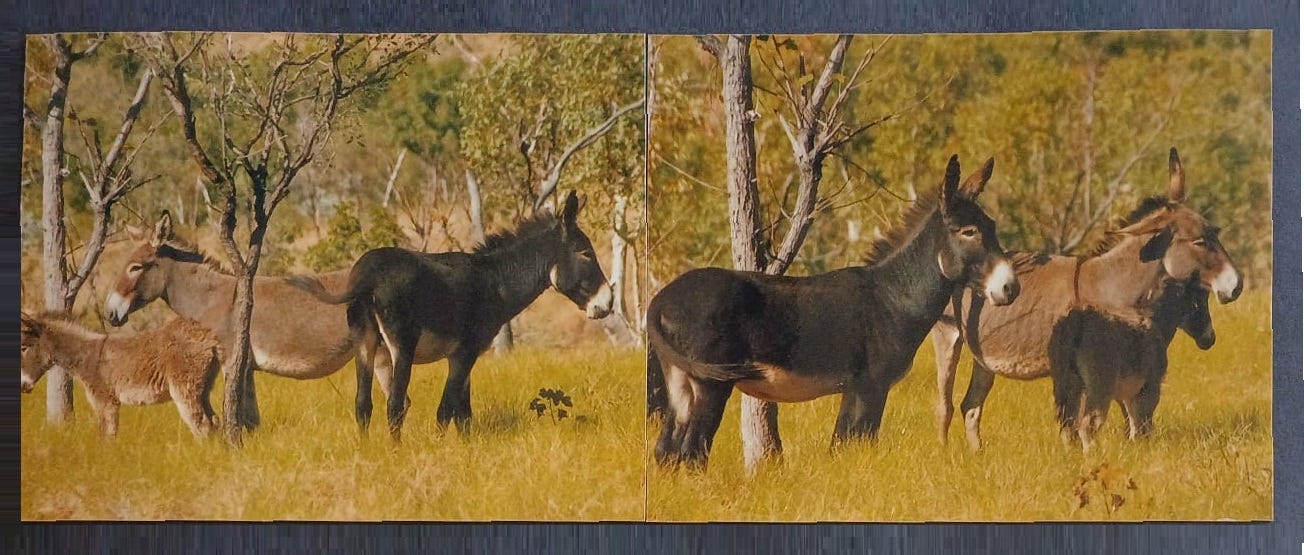
Managed Wild Donkeys at Kachana Station—Affable Firefighters in the Heart of the Outback
Australian Chris Henggeler, who runs land in the notoriously flammable Kimberley region, is about to lose his elite fire crew. And seventy donkeys stand to lose their lives. Looked at logically or morally—these are sentient, intelligent and social beings—this should not be happening. Despite strong evidence that the animals are improving the land and their behavior staves off damaging bushfires, Western Australian authorities have ruled the donkeys are to be killed, shot by helicopter at considerable expense, by the end of this month. Their crime? That they are not on the list of sanctioned species deemed native to the continent.
One theme that flows through my books is how animals create ecosystems, and how understanding this invites us to work with them to heal degraded landscapes. The way, for example, that beavers build wetlands teeming with life, or that reindeer maintain permafrost by traipsing across the snow, captured my imagination. I titled my book on soil Cows Save the Planet to highlight animal superpowers, and opportunities to ally with them to enhance environmental conditions. But no land-animal yarn has touched me as deeply as the wild donkeys of Kachana Station, those now with targets on their backs.
The basic story is this: Donkeys were brought to Australia in the 19th century as pack animals. The advent of motorized transport meant they were no longer needed, and many were let go. The donkeys ranged through the outback, forming family groups and thriving in wild, seemingly empty terrain. Western Australia (WA), the country’s largest and most remote state, determined that the animals were pests and population control was necessary. Over time, the WA 2007 Biosecurity and Agriculture Management Act has been pushed to justify eradication. More than a half million donkeys have been killed in the Kimberley alone.
Enter the Henggeler family, who in 1991 set up home at Kachana, a cattle station as big as Singapore. Kachana’s “product” is revitalized land: cattle are managed to enrich the soil and restore the water cycle—minimizing floods and droughts—and, most importantly, diminish the ever-looming threat of fire. By 1997 the Henggelers noticed that wild donkeys moseyed to rough, rocky spots where cows didn’t go, thereby controlling fire fuel in those areas. Without being asked, the donkeys had volunteered to join the fire brigade. The Henggelers adapted low-stress, pressure-release approaches to move the donkeys to specific sites where they could do the most good.
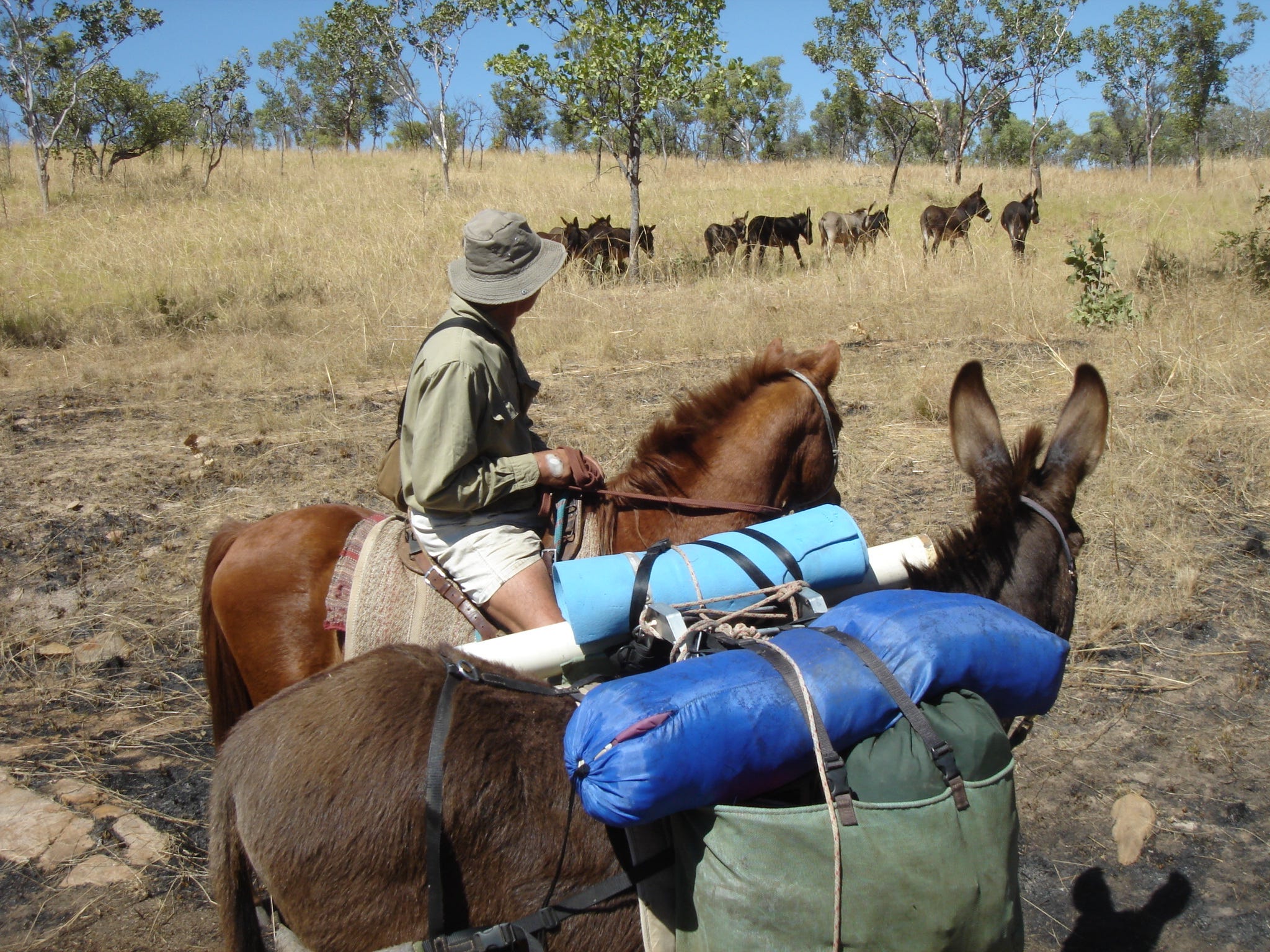
These locations saw lower fire intensity and accelerating land improvement. Scientists came to study donkey behavior and the biological processes they sparked. It seemed like a win all-around: Kachana curbed its fires; ecologists had a living laboratory for observing animal impact; the state would avoid the unpleasant and costly task of culling while 1) promoting internationally significant research and 2) potentially easing ongoing problems like downstream flooding. Except that the governmental bureaucracy, specifically the WA Department of Primary Industries and Regional Development, or DPIRD, insists that the donkeys must go, refusing multiple invitations to see the land for themselves.
Actually, this tale really starts not with 19th-century donkey carts, but rather tens of thousands of years ago. For the late Pleistocene Era saw the demise of Australia’s great megafauna, including the diprotodon (a marsupial the size of a hippo), marsupial lion (think lion with a kangaroo pouch), and giant wombat. Without these critters to prune vegetation and cycle nutrients and biomass, the continent’s ecology was greatly diminished.
It was this attenuated state, marked by aridity and fire-adapted flora, that early European settlers first encountered. And yet, points out Australian ecologist Arian Wallach, this “post mass-extinction world” set the accepted standard for which species are considered “native”. The prevailing notion of what “belongs” in Australia is based on ideology, not science, she says in an interview with The Country Telegraph. “There’s nothing empirical to say that a Kimberley without donkeys is more ‘real’,” she says. She suggests that it would, however, be more combustible. In sum, Australia’s wild donkeys are filling ecological niches that have been void since the last geological age. In Wallach’s words: “Donkeys appear to have stepped into the pawprints of Australia’s lost giant wombat.”
Per the scientists, here are just a few ways the donkeys at Kachana benefit the land:
In parched areas, donkeys dig wells (the technical term for these is “ass holes”), providing water for multiple other species as well as themselves
Donkeys interrupt “fire ladders”, when flames scale up trees. In the Kimberley, the bark of certain tea trees is especially flammable. Once ignited, grass fires can erupt into a canopy blaze. Donkeys (and cattle) eat this bark, potentially offering a tool for fire control.
Donkeys create “spas”: spots dedicated to dust-bathing for scratching, exfoliating and recreating. These bare areas become small fire breaks that may influence the movement of fire across the landscape.
This in addition to the general positive impact of well-managed herbivores, such as pressing senescent plant material into the soil, adding moisture and fertility through their waste, transporting and depositing seeds via their dung.
Reducing donkey numbers would derail Kachana’s hard-won progress in several ways. For one, it would effectively end the research—studies already yielding valuable insights for dryland ecosystems, which account for a significant chunk of global landscapes. It would stall ecological improvements, in part because few animals leads to less impact, but also because the slaughter would break the donkeys’ trust and thereby change their behavior. The donkeys now respond to management and move as a herd. With group members killed, they would be less amenable to direction from humans. Rather, they would express their fight-and-flight instincts as individuals and scatter.
However, all this could change with a simple shift of mindset: the healthy donkey population in the Kimberley could be regarded as a great feat of rewilding rather than seen as an “invasion”. This tiny revision would make all the difference to the Henggelers, ranchers and other land managers, research ecologists, those living in fire-prone regions, and, most urgently, these precious animals that want to be partners with us.
Join me in calling for Western Australia’s DPIRD agency to #STOP THE DONKEY CULL
For more information:
The Henggelers featured on Australian Story
Report in the Sydney Morning Herald
Kachana’s Wild Donkey Project
Several episodes of the Regennaration with Anthony James, starting here
Interview with Dr. Arian Wallach
Arian Wallach’s videos: Australian Wild Donkey and the excellent Feminist Ferals
Invisible Megafauna paper by Wallach et. al.
Heart-breaking! Please don’t forgot who famously rode a donkey. Jesus. What a beautiful animal. How unholy to even consider this fate. They should be adopted by congregations. I’d adopt one if we were allowed in San Francisco.
Australian Donkey Sanctuaries: Organizations operating inside Australia, like the https://donkeyrescue.org.au/, are the primary groups that navigate Western Australian biosecurity laws to rehabilitate and legally rehome donkeys. [https://donkeyrescue.org.au/]
While https://www.episcopalrelief.org/ handles international relief, its mandate is strictly limited to human-centric humanitarian development, poverty alleviation, and disaster response. It does not operate animal sanctuaries or handle wildlife management disputes with foreign governments.
“Australian Donkey Sanctuaries: Organizations operating inside Australia, like the https://donkeyrescue.org.au/, are the primary groups that navigate Western Australian biosecurity laws to rehabilitate and legally rehome donkeys. [https://donkeyrescue.org.au/]
Global Equine Protection: Global animal welfare giants like https://www.thedonkeysanctuary.ca/international-donkey-welfare/ have the legal teams and infrastructure to tackle systemic welfare crises and campaign against mass culls internationally. [https://www.thedonkeysanctuary.ca/international-donkey-welfare/]
Direct Advocacy: The author of the article explicitly recommends applying pressure directly to the culling agency via the #STOP THE DONKEY CULL social media campaign or engaging with the Kachana Wild Donkey Project directly to amplify their message before the end-of-the-month deadline.
Would you like help drafting a petition letter to DPIRD or finding contact details for equine rescue groups based in Western Australia?
Excellent Judith. The importance of grazing animals in reducing fire risk is emerging and the experience at Kachana is providing important data.